
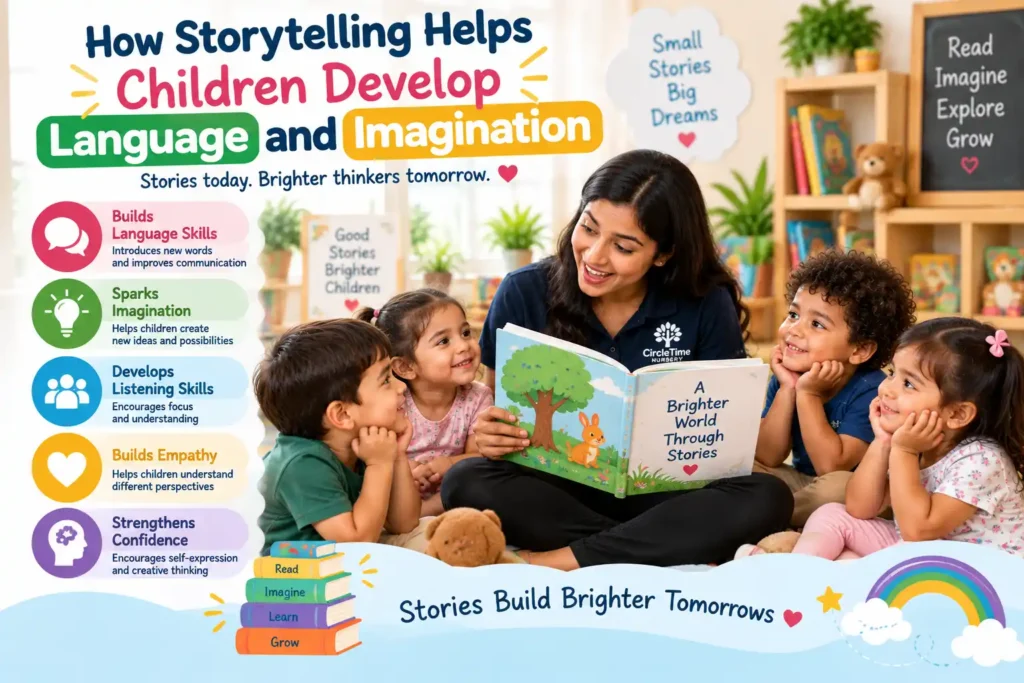
How Storytelling Helps Children Develop Language and Imagination
Long before children can read, they’re already falling in love with stories. That moment when a toddler points at a picture book and says “again” isn’t just cute — it’s actually one of the most powerful learning tools we have for young minds. Storytelling has been around for as long as humans have talked to each other, and it turns out it’s still one of the best ways to help a child build language and imagination.
Why Stories Matter More Than We Give Them Credit For
Here’s something worth thinking about: a normal day of conversation with a toddler rarely goes beyond “eat your breakfast” or “time to put on shoes.” Stories change that completely. Suddenly a child is hearing words like “enormous,” or “mischievous,” or “the sun dipped below the hills.” That’s a much richer vocabulary than daily life usually offers, and kids soak it up without even trying.
This is exactly why a good nursery in Dubai doesn’t treat story time as a nice-to-have. It’s built into the day, not squeezed in as an afterthought.
What Actually Happens in a Child’s Brain During a Story
When a child listens to a story, several things are happening at once, even if it doesn’t look like much from the outside. They’re picking up new words in context, which sticks far better than memorizing vocabulary lists ever could. They’re also learning that stories have a shape — something happens at the start, things get complicated in the middle, and it wraps up at the end. That sense of structure quietly teaches sequencing, a skill that shows up again later in maths, in writing, even in explaining what happened at the park.
At a best nursery in Dubai, you’ll often hear teachers pause mid-story to ask things like “what do you think happens next?” or “how do you think she’s feeling right now?” Small questions like that turn a passive listening moment into active thinking.
And Then There’s Imagination
Give a child a story about a dragon who’s afraid of the dark, or a mouse who sails across the ocean in a teacup, and something interesting happens — their mind has to go somewhere it’s never been. That stretch, picturing something that doesn’t exist in front of them, is basically imagination in training. It’s the same mental flexibility they’ll later use to solve problems creatively or come up with their own pretend games.
In fact, most children eventually start doing this in reverse. After hearing enough stories, they begin inventing their own during play, borrowing bits and pieces from what they’ve heard and mixing it into something completely new. Anyone who’s overheard a child narrating an elaborate scenario involving toy dinosaurs and a tea party knows exactly what this looks like.
What Kids Actually Gain From Regular Storytelling
A few things tend to show up consistently in children who hear stories often:
- Bigger vocabulary. Simply put, they hear more words than they would otherwise.
- Better listening. Following a story from start to finish takes real attention, and that’s a skill that pays off in the classroom later.
- A stronger grasp on emotions. Characters get scared, excited, disappointed — and kids start recognizing those same feelings in themselves.
- An understanding of sequence. Beginning, middle, end. It sounds simple, but it’s a building block for a lot of later learning.
- Sharper imagination. The more worlds a child gets to picture, the more comfortable they become inventing their own.
How This Actually Plays Out During the Day
A nursery in Dubai that takes this seriously doesn’t just tick a box with one story session in the morning. It shows up in circle time chats, in puppet play, even in small moments like narrating a block tower as if it’s “on an adventure.” That kind of constant, casual exposure does more over time than a single scheduled reading ever could.
That’s really the difference between a best nursery in Dubai and one that treats storytelling as filler between the “real” activities. In truth, it’s doing just as much heavy lifting as anything labeled academic.
If You’re Comparing Nurseries, Here’s What to Watch For
When you’re touring a nursery in Dubai, don’t just ask if there’s a story time on the schedule. Ask how often storytelling shows up throughout the day in smaller, less formal ways. Watch whether teachers ask open questions during a story, or just read straight through without pausing. Notice whether children are ever invited to retell a story in their own words, or come up with their own ending.
A Few Questions Parents Often Ask
1) When should storytelling start?
Honestly, much earlier than most people expect. Even very young toddlers benefit from simple, repetitive picture books, long before they can follow a full plot.
2) Does this actually help with reading later on?
Yes, quite directly. The vocabulary and comprehension built through storytelling feed straight into early reading once formal literacy starts.
3) What about bilingual kids?
Stories in more than one language can genuinely strengthen both, especially somewhere like a best nursery in Dubai where multilingual exposure is already part of daily life.
4) Can parents keep this going at home?
Definitely. Reading together, pausing to ask “what do you think happens next,” or letting your child retell a story their own way all build on exactly what’s happening at nursery.
The Bottom Line
Storytelling isn’t just a quiet, cosy moment in the day, though it’s certainly that too. It’s genuinely one of the most effective ways young children build both language and imagination, and it works best when it’s woven throughout the day rather than boxed into one session. A nursery in Dubai that treats stories this way is giving children something that pays off for years, long after they’ve forgotten which book it even came from.