
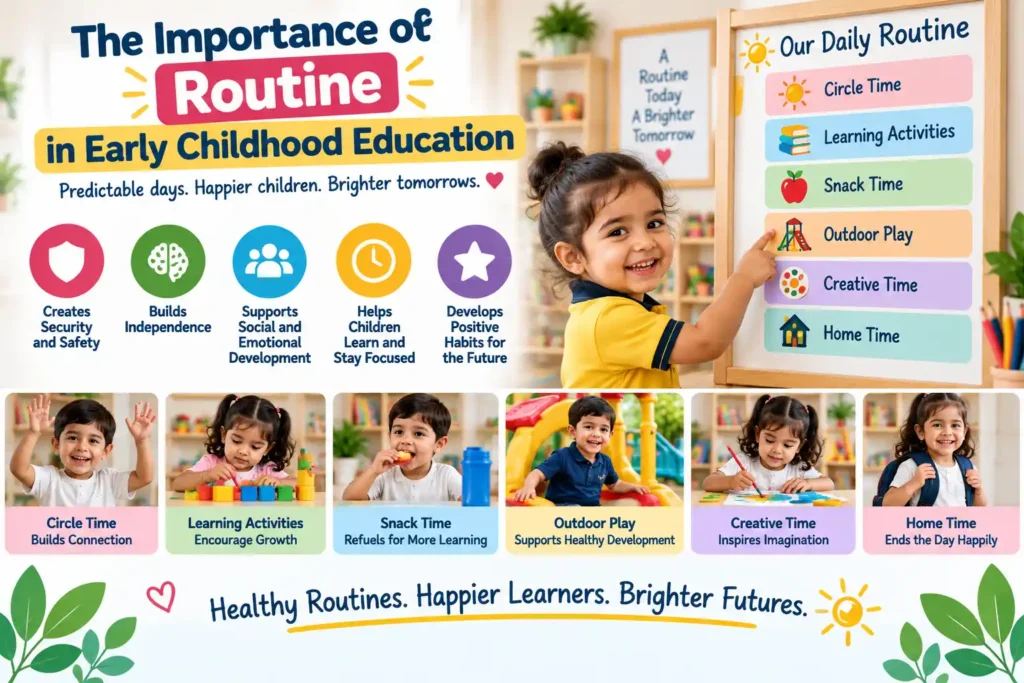
The Importance of Routine and Structure in Early Childhood Education
Consistency might not sound exciting, but for young children, it’s one of the most powerful tools available. Routine in early childhood education does far more than keep a classroom organized; it shapes how safe, confident, and ready to learn a child actually feels each day, which is why routine in early childhood education is treated as a foundation rather than an afterthought in strong programs.
Why Routine in Early Childhood Education Matters So Much
Young children have limited ability to predict what happens next in their world, which can make everyday life feel uncertain. A consistent routine in early childhood education removes much of that uncertainty, giving children a clear sense of what’s coming, breakfast, then play, then circle time, then lunch. That predictability frees up mental and emotional energy that would otherwise go toward managing surprise or anxiety, and it’s a large part of why routine in early childhood education is prioritized so heavily by experienced educators.
This is exactly why a nursery in Dubai built around a strong daily routine tends to see children settle in faster and engage more confidently than one with a looser, less predictable structure.
How Structure Supports Emotional Security
Structure for toddlers isn’t about rigid rules; it’s about reliability. When a child knows the shape of their day in advance, transitions between activities become far less stressful. A predictable goodbye routine at drop-off, a consistent nap schedule, and clear signals for moving between activities all reduce the small daily anxieties that can otherwise build up over time.
A best nursery in Dubai typically treats this kind of structure for toddlers as foundational, not incidental, understanding that emotional security has to come before a child can genuinely engage with learning.
Key Benefits of Routine and Structure
Well-designed routine in early childhood education delivers benefits across several areas of development at once:
Reduced anxiety. Predictability lowers the stress that comes from constant uncertainty about what happens next.
Better behavior regulation. Children generally manage transitions and frustration more smoothly when they know what to expect.
Stronger independence. Familiar routines allow children to anticipate steps themselves, like washing hands before snack time, without needing constant reminders.
Improved sleep and eating patterns. Consistent nap and meal timing regulates a child’s internal clock, which in turn affects mood and energy throughout the day.
More effective learning. A calm, secure child is simply more available for genuine engagement and exploration than an anxious or overstimulated one.
Structure for Toddlers Doesn’t Mean Rigid Control
It’s worth separating healthy structure for toddlers from overly rigid scheduling. The goal isn’t to control every minute, but to provide a reliable overall shape to the day, arrival, structured activities, free play, meals, rest, while still leaving room for spontaneity and choice within that framework. Too much rigidity can actually work against curiosity and independent exploration.
How This Looks in a Strong Nursery Program
A well-run nursery in Dubai builds routine in early childhood education into every part of the day without making it feel mechanical. Visual schedules, consistent transition songs or cues, and predictable staff presence all reinforce this kind of routine in early childhood education gently rather than through strict enforcement.
This balance is part of what separates a best nursery in Dubai from a setting that either lacks structure entirely or applies it so rigidly that children have little room to explore within it.
Signs a Nursery Gets This Balance Right
A nursery that genuinely applies routine in early childhood education well tends to show a few consistent signs:
- A visible, consistent daily schedule shared with parents
- Calm, predictable transitions between activities
- Room for choice and free play within the overall structure
- Consistent staff and routines, rather than frequent, unexplained changes
Questions to Ask When Comparing Nurseries
- What does a typical daily schedule actually look like?
- How are transitions between activities handled?
- How much flexibility exists within the daily routine for individual children?
- How consistent is staffing and daily structure across the week?
Frequently Asked Questions
1) Can too much routine limit a child’s creativity?
Healthy structure for toddlers still leaves room for choice and free play. It’s rigid, inflexible scheduling, not routine itself, that tends to limit creativity.
2) How quickly do children adjust to a new routine?
Most children adapt within a few weeks, especially when transitions are introduced gradually and consistently reinforced.
3) Does routine in early childhood education matter more at home or at a nursery in Dubai?
Both settings benefit from consistency, and aligning routines between home and nursery, similar meal or nap timing, for example, often makes transitions even smoother.
4) What’s the difference between routine and structure?
Routine typically refers to the specific sequence of daily events, while structure refers to the broader framework, expectations, and consistency surrounding those events.
Final Thoughts
Routine in early childhood education isn’t about rigid control; it’s about giving children the predictability they need to feel secure enough to explore, learn, and grow. Getting routine in early childhood education right means balancing consistency with genuine flexibility, not choosing one over the other. A best nursery in Dubai that balances consistent structure for toddlers with genuine room for choice tends to produce calmer, more confident learners than one relying on either strict rigidity or unpredictable freedom alone.