
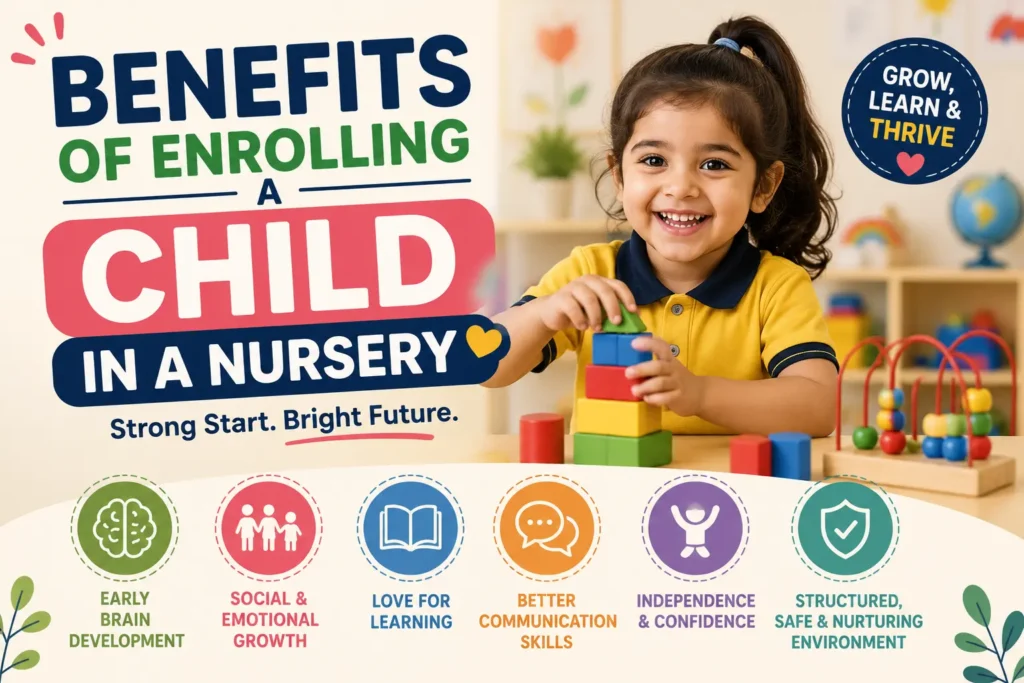
Benefits of Enrolling a Child in a Nursery
Meta Title: Benefits of Enrolling a Child in a Nursery | Early Years Guide Meta Description: Discover the key benefits of nursery education, from social skills to school readiness, and why early years enrollment matters for child development.
Deciding when and whether to enroll a child in a nursery is one of the first major parenting decisions many families face. It’s natural to feel torn between wanting to keep a toddler close to home and recognising the value of structured early learning. The good news is that quality nursery education offers benefits that extend well beyond simply “getting used to school,” shaping how children think, communicate, and relate to the world around them.
Below is a closer look at why nursery enrollment matters, and what parents can realistically expect from the early years.
- Early Social Skills Development
One of the most immediate benefits of nursery is exposure to structured social interaction. At home, a child’s social world is often limited to family members and the occasional playdate. In a nursery setting, children learn to share, take turns, negotiate small conflicts, and build friendships with peers their own age, skills that are difficult to replicate outside a group environment.
These early social experiences lay the groundwork for empathy, cooperation, and confidence in group settings later in life, whether that’s a primary school classroom or, eventually, a workplace.
- Language and Communication Growth
Nurseries are rich language environments. Between storytelling sessions, group conversations, songs, and guided play, children are consistently exposed to new vocabulary and sentence structures in ways that accelerate language development. For many toddlers, nursery is where they first learn to express needs, ask questions, and describe their world with growing independence.
This is particularly valuable for children being raised in multilingual households, where nursery can provide focused exposure to a language they may hear less often at home.
- Structured Routine and Independence
Nurseries introduce children to daily routines, mealtimes, nap schedules, circle time, and clean-up, that help them understand structure and predictability. Over time, this builds a sense of independence: children learn to manage small tasks on their own, from washing hands to putting away toys, without constant parental guidance.
This gradual shift toward independence is one of the most noticeable changes parents report after a few months of nursery attendance.
- Cognitive and Early Learning Foundations
Play-based early years curriculums are designed to introduce foundational cognitive skills, early literacy, numeracy, problem-solving, and pattern recognition, through hands-on activities rather than formal instruction. Organisations such as the National Association for the Education of Young Children (NAEYC) have long emphasised that young children learn best through play, and these concepts are absorbed naturally, through building blocks, sorting games, storytime, and creative play.
This foundation matters later: children who attend a structured nursery programme often transition into kindergarten and primary school with stronger pre-literacy and pre-numeracy skills.
- Emotional Regulation and Confidence
Nursery gives children a safe space to experience a wider range of emotions, excitement, frustration, disappointment, pride, outside the home, with trained educators guiding them through those moments. Research summarised by ZERO TO THREE, a leading early childhood development organisation, points to this kind of guided emotional experience as central to building resilience and self-regulation in the early years.
Confidence naturally grows alongside this. As children master small milestones, using scissors, completing a puzzle, saying goodbye to a parent without tears, they build a genuine sense of accomplishment.
- School Readiness
Perhaps the most practical benefit for many parents is school readiness. Children who attend nursery, particularly in the year or two before starting primary school, tend to adjust more smoothly to classroom routines, group instruction, and structured learning environments. They’re often more comfortable following instructions, sitting through group activities, and separating from parents for extended periods.
This doesn’t mean children who skip nursery are unprepared for school, but a well-designed early years programme can meaningfully ease that transition.
- Support for Working Parents
While not a developmental benefit for the child directly, it’s worth acknowledging that nursery enrollment also provides working parents with reliable, structured childcare during the day. Knowing a child is in a safe, engaging, supervised environment allows parents to focus on work commitments without compromising on their child’s care or development.
What to Look for When Choosing a Nursery
Not all nurseries deliver these benefits equally. When evaluating options, parents generally look for:
- A licensed or regulatory-approved curriculum
- Low child-to-teacher ratios for individual attention
- A play-based, age-appropriate learning approach
- Clear safety and hygiene protocols
- Transparent communication with parents about a child’s progress
- A warm, welcoming environment where children feel emotionally secure, not just academically engaged
Final Thoughts
Nursery enrollment offers far more than childcare, it’s an early investment in a child’s social, emotional, cognitive, and language development. The right environment, one that balances structure with warmth and play with purpose, can set the tone for a child’s entire relationship with learning.
For parents comparing local options, it’s worth visiting a few centres in person, observing a classroom in session, and asking directly about curriculum approach, teacher qualifications, and daily routines before making a decision. You can also get in touch with our team with any questions, or view our nursery fees and program pricing to help plan ahead.