
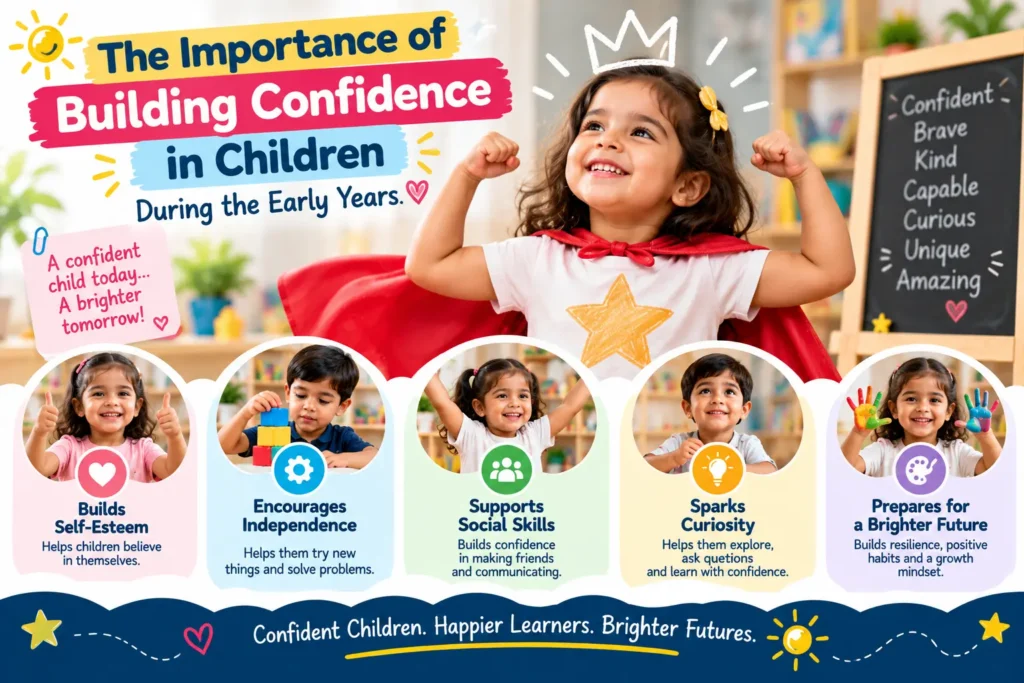
The Importance of Building Confidence in Children During the Early Years
Ask any experienced early years teacher what separates a child who thrives from one who struggles, and the answer is rarely about letters or numbers. It’s about belief. A child who trusts their own abilities will try the puzzle again, speak up in circle time, and walk into a new room without clinging to the doorframe. That’s why building confidence in children during the early years deserves a place at the very top of every parent’s priority list.
Why Building Confidence in Children Starts So Early
Self-belief isn’t something that switches on at school age. It begins forming in infancy, shaped by how adults respond to a baby’s cries, smiles, and first attempts to reach for things. The Harvard Center on the Developing Child describes how responsive, back-and-forth interactions with caregivers lay the groundwork for emotional security, and emotional security is the soil in which confidence grows.
Children who feel safe, noticed, and capable tend to take healthy risks. They explore, make mistakes, and bounce back. Those who feel constantly corrected or overlooked often hesitate, and that hesitation can quietly shape how they approach learning for years. A nursery in Dubai that understands this connection builds its daily routines around encouragement rather than correction.
What Building Confidence in Children Actually Looks Like
Confidence in a three-year-old rarely looks like bold speeches. It’s usually quieter:
- Saying “I do it myself” while wrestling with a coat zip
- Raising a hand to answer, even when unsure
- Trying a new activity without waiting for an adult to go first
- Recovering from a tumble or a lost game without prolonged distress
- Asking for help calmly when a task is genuinely too hard
The American Academy of Pediatrics highlights independence and self-help skills as key markers of healthy preschool development, and each small success feeds the next one.
How Building Confidence in Children Shapes Learning and Behavior
Willingness to Try
Children who feel confident treat mistakes as information rather than failure. That mindset supports problem-solving, creativity, and resilience, which the National Association for the Education of Young Children links closely with social and emotional learning.
Language and Communication
Children who feel secure are far more likely to chat, ask questions, and share ideas. Groups of peers become practice grounds for vocabulary and storytelling, and every successful exchange strengthens their sense of “I have something worth saying.”
Friendships and Social Skills
Self-assured children tend to join games, share more easily, and handle disagreements without falling apart. Zero to Three notes that early social-emotional foundations influence relationships well into later childhood.
Transition to Primary School
The move to a larger, more structured classroom is far smoother for a child who already trusts themselves. Research summarised by the OECD repeatedly connects strong early social-emotional skills with better adjustment and achievement later on.
Practical Ways of Building Confidence in Children at Home
Building confidence in children doesn’t need special equipment. Small, consistent habits do most of the work:
- Offer real choices. “Red cup or blue cup?” gives a toddler a genuine sense of control.
- Praise effort, not just results. “You kept going even though that was tricky” builds persistence better than “good girl” or “clever boy.”
- Let them struggle a little. Waiting a few extra seconds before stepping in teaches children they can cope.
- Hand over small responsibilities. Watering a plant or setting out napkins makes a child feel useful.
- Stay calm after mistakes. Your reaction to a spilled drink teaches more than any lecture.
The Child Mind Institute offers further, research-informed guidance on supporting self-esteem through everyday parenting moments.
How a Quality Nursery Supports Building Confidence in Children
Children spend a large share of their waking hours in nursery, so the environment matters enormously. A best nursery in Dubai will weave confidence-building into the structure of the day: independent snack and tidy-up routines, show-and-tell moments, small-group activities where every voice is heard, and teachers who notice effort and name it.
The UK’s Early Years Foundation Stage framework places personal, social and emotional development at the heart of early learning, precisely because confidence underpins everything else. You can see how this thinking translates into daily practice through CircleTime’s curriculum, which pairs skill-building activities with a warm, encouraging classroom atmosphere.
What to Look for When Choosing a Nursery
When you tour a nursery in Dubai, watch the adults as closely as the activities. Do teachers crouch to a child’s eye level? Do they celebrate small attempts? Are children given jobs, choices, and time to try things themselves?
Dubai’s regulator, the Knowledge and Human Development Authority, publishes inspection information that helps families compare early years providers, and it’s a sensible starting point before visiting in person. The World Health Organization also stresses nurturing care, responsive, safe, and stimulating, as the foundation of healthy early development.
Common Mistakes That Undermine Building Confidence in Children
- Over-helping. Doing everything for a child sends the message that they can’t.
- Comparing siblings or classmates. Even gentle comparisons can sting.
- Empty praise. Constant “amazing!” without substance loses meaning quickly.
- Rushing. Hurrying a child through tasks leaves no room to feel capable.
- Dismissing fears. Acknowledge worries first, then problem-solve together.
The Centers for Disease Control and Prevention offers age-by-age positive parenting tips that fit naturally alongside these everyday habits, and Edutopia collects classroom-tested strategies that educators use to support self-belief.
Frequently Asked Questions
1) At what age should parents start building confidence in children?
From the very beginning. Responding warmly to a baby’s signals is already building confidence in children, long before they can talk.
2) Is a shy child less confident?
Not necessarily. Shyness is a temperament trait, while confidence is about trusting one’s abilities. A quiet child can be perfectly self-assured with the right support and time to warm up.
3) Can too much praise backfire?
It can. Specific, honest feedback about effort and progress helps far more than constant general compliments.
4) How does nursery help with confidence?
Regular routines, group activities, independent tasks, and encouraging teachers give children repeated chances to succeed in small ways, which adds up over months.
Final Thoughts
Building confidence in children is not a luxury reserved for outgoing personalities. It’s a skill, grown through safe relationships, small wins, and adults who believe in the child in front of them. Choosing a best nursery in Dubai that treats self-belief as seriously as early literacy gives your child a foundation that will serve them in every classroom and friendship to come. If you’d like to see this approach in action, visit the nursery’s contact page to arrange a conversation or a tour.