
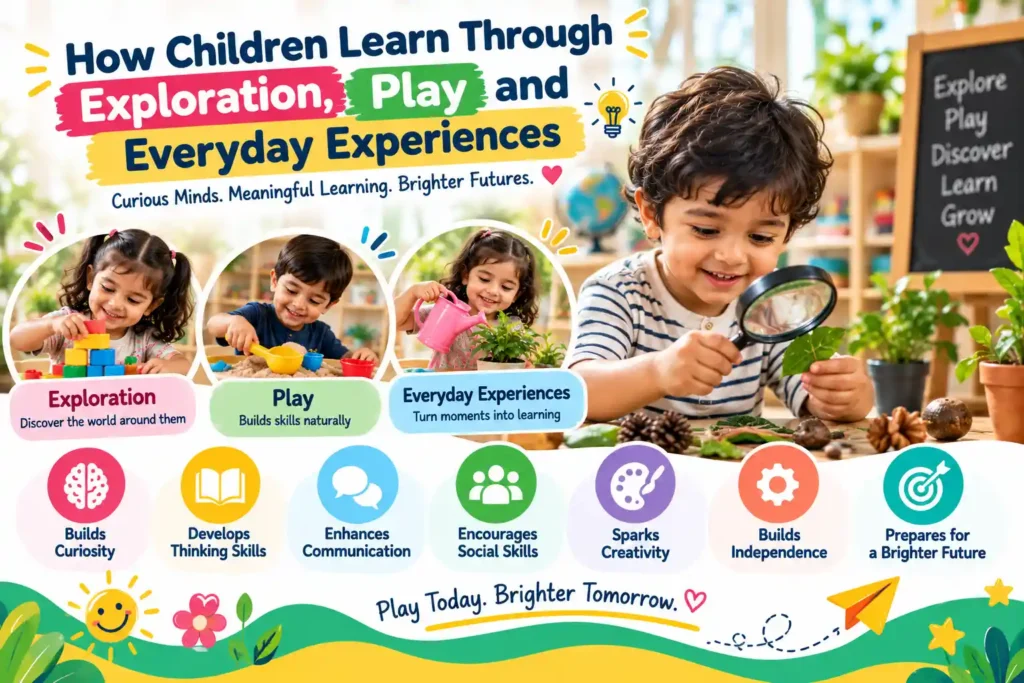
How Children Learn Through Exploration, Play and Everyday Experiences
Long before formal schooling begins, children are already learning constantly, through touching, tasting, questioning, pretending, and simply living through an ordinary day. Understanding how children learn through exploration and play helps parents and educators create environments where real development happens naturally, rather than relying on worksheets or rigid instruction to do the work.
Why Exploration and Play Are the Foundation of Early Learning
Research from the Harvard Center on the Developing Child shows that early brain architecture is built through “serve and return” interactions, the back-and-forth exchanges between a child and their environment or caregiver. Play isn’t a break from learning; according to the American Academy of Pediatrics, it’s one of the primary mechanisms through which learning actually happens in early childhood.
That’s precisely why a nursery in Dubai built around hands-on exploration and play, rather than one that treats them as an afterthought, usually sees noticeably stronger developmental results than a setting leaning on passive, instruction-heavy routines.
How Children Learn Through Everyday Exploration
Learning Through Sensory Discovery
Touching different textures, splashing water, or digging through sand lets children gather information about the physical world directly. The National Association for the Education of Young Children (NAEYC) notes that sensory-rich exploration strengthens cognitive pathways tied to problem-solving and early scientific thinking.
Learning Through Pretend and Imaginative Play
Role-play, dress-up, and make-believe scenarios let children rehearse real-world situations in a low-stakes setting. Zero to Three highlights pretend play as a critical way young children build empathy, language, and problem-solving skills simultaneously.
Learning Through Social Interaction
Children learn enormous amounts simply by watching and interacting with peers and adults. Turn-taking, sharing, and resolving small conflicts during everyday play build social-emotional skills that structured lessons rarely replicate as effectively, a point echoed by UNICEF’s early childhood development resources.
Learning Through Repetition and Routine
Everyday routines, mealtimes, getting dressed, tidying up, teach sequencing, independence, and responsibility. The predictability of routine gives children the emotional security to explore more confidently elsewhere in their day, a connection well documented by the World Health Organization.
Learning Through Outdoor and Nature-Based Exploration
Climbing, running, and observing the natural world build gross motor skills alongside curiosity and scientific thinking. The Centers for Disease Control and Prevention notes that outdoor physical activity also supports healthy brain development during early childhood.
The Role of a Quality Nursery in Supporting Exploratory Learning
A best nursery in Dubai plays a significant role in how consistently children get access to rich exploration and play-based learning. Structured free play, guided discovery, and varied daily activities compound over time in ways that occasional exposure simply can’t match.
This aligns closely with the UK’s own early years framework. The Early Years Foundation Stage (EYFS) framework, followed by many British-curriculum nurseries, explicitly places play-based learning at the center of how young children are taught, rather than treating it as a supplement to formal instruction.
What Strong Exploration-Based Learning Looks Like
- Daily access to open-ended materials like blocks, sand, water, and art supplies
- A balance of child-led free play and gently guided activities
- Regular outdoor time for physical exploration and nature-based discovery
- Opportunities for pretend play and storytelling throughout the day
- Consistent routines that still leave room for curiosity and spontaneity
CircleTime’s curriculum puts this thinking into practice by weaving exploration and play into every major developmental area throughout the day, instead of boxing it into one isolated activity slot.
How KHDA Standards Support Play-Based Learning in Dubai
Nurseries in Dubai operate under oversight from the Knowledge and Human Development Authority (KHDA), which evaluates curriculum quality, including how well play and exploration are integrated into daily practice. When comparing a nursery in Dubai, checking a provider’s KHDA rating is a practical way to gauge whether hands-on, exploratory learning is genuinely prioritized rather than just mentioned in a brochure.
International bodies echo this same emphasis. The OECD’s early childhood education research consistently finds that high-quality, play-based early education correlates strongly with better long-term academic and social outcomes.
Frequently Asked Questions
1) Does free, unstructured play carry as much value as structured activities?
Yes. According to Edutopia, unstructured, child-led play builds problem-solving, creativity, and self-regulation skills that are just as important as skills built through structured activities, and the two work best in combination.
2) At what stage of childhood does play-based learning have the biggest impact?
The first five years, when brain development is fastest, is when exploration and play have the most significant developmental impact, though the benefits of play-based learning continue well beyond early childhood.
3) How can parents support exploration-based learning at home?
Simple additions like open-ended toys, outdoor time, and unstructured free play at home reinforce the same kind of learning children experience through nursery activities during the day.
4) Does play-based learning prepare children adequately for formal schooling?
Yes. Research consistently shows that strong early foundations built through play translate into stronger readiness for structured academic learning later on, rather than working against it.
Final Thoughts
Children learn constantly through exploration, play, and everyday experiences, often absorbing more through a sandbox or a pretend tea party than through any worksheet. Opting for a best nursery in Dubai where exploration and play sit at the heart of a real, structured curriculum, not just loose supervision, sets children up with a genuinely stronger base for what’s ahead. To find out exactly how a typical day is run, getting in touch through a nursery’s contact page is a straightforward way to ask the specific questions that matter before you commit.