
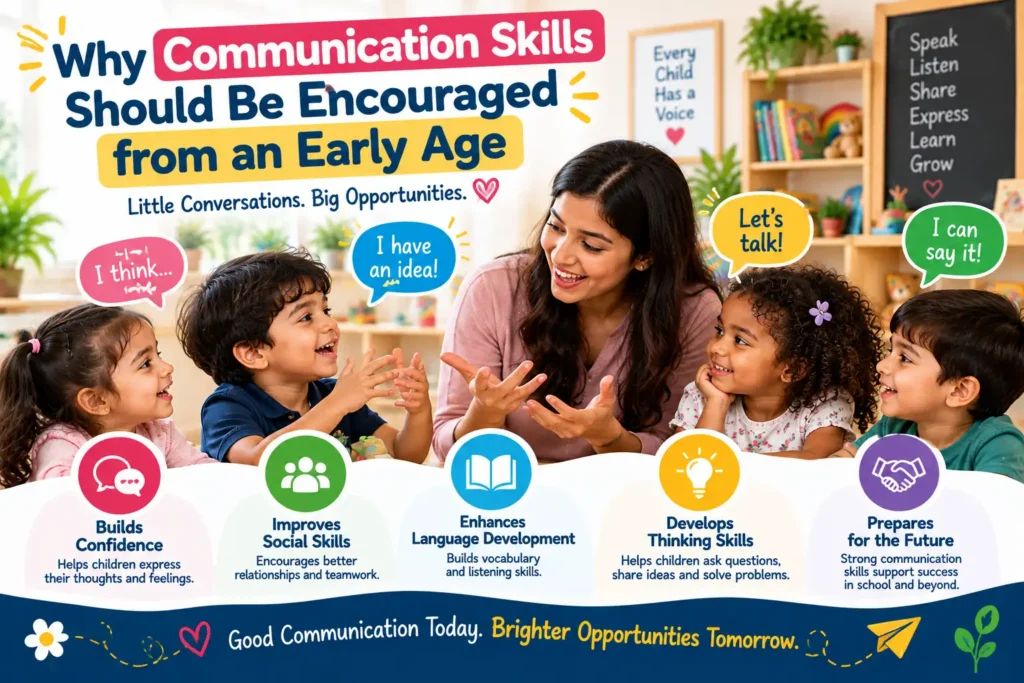
Why Communication Skills Should Be Encouraged from an Early Age
A toddler pointing at a bird and saying “bir!” for the first time is doing something far bigger than learning a word. They’re taking the earliest steps toward a lifelong skill that will shape friendships, classroom success, and confidence in almost every situation they’ll ever face. Nurturing communication skills in early childhood isn’t a nice-to-have extra, it’s one of the most practical things a parent or nursery can prioritize, and strong communication skills in early childhood deserve far more intentional attention than they usually get.
What Makes Communication Skills in Early Childhood So Important
The brain soaks up language faster in the first few years than it ever will again. Every time a caregiver chats, sings, or simply responds to a baby’s babble, a small piece of the wiring for speech, understanding, and social awareness gets stronger. Toddlers who get regular chances to practice communication skills in early childhood generally start school with richer vocabularies, sharper listening habits, and more comfort speaking up in a group.
When those chances are missing, the effects tend to show up quietly, in strained friendships, frustration that boils over into tantrums, or early reading struggles, since spoken language and literacy are so closely linked. That’s precisely why a nursery in Dubai that treats everyday conversation as a core part of the day, rather than an occasional add-on, ends up making such a visible difference.
The Building Blocks of Early Communication
Understanding What’s Being Said
Before a child can speak clearly, they first need to make sense of what others are saying to them. Everyday chatter, bedtime stories, and simple step-by-step instructions all strengthen this comprehension, and comprehension is the groundwork everything else gets built on.
Finding the Words
Vocabulary explodes somewhere between ages two and five. Prompting a child to describe what’s in front of them, ask “why,” or narrate their own play does more for communication skills in early childhood than any amount of passive screen time ever could.
Reading the Room Without Words
A raised eyebrow, a wave, a frustrated frown, these are forms of communication too, and they tend to develop right alongside spoken language. Kids who are gently coached to notice body language and facial cues usually get better at reading social situations as they get older.
Taking Turns and Listening
Waiting for a turn to speak, actually listening while someone else talks, responding in a way that fits the conversation, these habits come almost entirely from real back-and-forth with other children and adults, not from being taught in the abstract. This social layer is often the hardest part of communication skills in early childhood to build, since it requires practice with real people, not just vocabulary.
Why Encouragement Early On Makes Such a Noticeable Difference
No child is simply born a confident communicator, it’s a skill shaped bit by bit through repetition, good modeling, and plenty of encouragement. A best nursery in Dubai carries real weight here, since children spend hours every day surrounded by trained teachers and peers who demonstrate strong communication as a matter of routine.
Skip that consistent encouragement, and children often fall back on frustration, meltdowns, or going quiet instead, simply because they haven’t yet built up the words or the confidence to ask for what they need. Making communication skills in early childhood a daily priority closes that gap considerably.
Simple, Everyday Ways to Build Communication Skills
- Talk through ordinary routines out loud, even something as small as getting dressed or packing a snack
- Swap yes-or-no questions for open-ended ones that invite a real answer
- Read together daily, pausing to ask what might happen next in the story
- Resist the urge to finish a child’s sentence for them, give them the extra few seconds
- Let pretend play run its course, since it naturally pulls in dialogue and storytelling
You can see this approach in action through CircleTime’s curriculum, which folds conversation and language-building into the rhythm of the day instead of treating it as a separate lesson.
What to Look for in a Nursery’s Approach to Communication
When you’re comparing a nursery in Dubai, ask directly how communication skills in early childhood are worked into daily life there. A genuinely strong program should be able to walk you through how storytelling, conversation, and peer interaction show up across a typical day, not just gesture vaguely at “language activities.”
Small class sizes and steady teacher-to-child ratios matter a great deal here too, since children need frequent, one-on-one exchanges to really practice these skills, something that’s much harder to pull off in larger, looser groups. Nurseries that track progress in communication skills in early childhood with real feedback, rather than general reassurance, tend to send noticeably more confident speakers on to primary school.
Frequently Asked Questions
1) Why does so much advice focus on communication skills in early childhood rather than academics?
Because communication underpins nearly every other skill. A child with strong communication skills in early childhood finds it easier to ask for help, resolve conflicts, and absorb new concepts later on, which makes it a foundation rather than a competing priority.
2) At what age should communication skills in early childhood start being encouraged?
Right from infancy. Even before a baby forms full words, responding to their babbling, making eye contact, and narrating what you’re doing together all lay the groundwork for stronger language later on.
3) Can a shy or quiet child still build strong communication skills?
Absolutely. Temperament shapes someone’s communication style, not their ceiling. Given patience and low-pressure chances to speak up, quieter children often end up just as capable communicators as their more outgoing classmates.
4) Does learning two languages at once slow a child down?
Not typically. Research generally shows that children raised around multiple languages build solid communication skills in both, sometimes after a brief adjustment period that sorts itself out naturally.
5) What can parents do at home to support this?
Reading together, asking questions that invite more than one-word answers, and actually listening to how a child responds all reinforce the same communication skills they’re practicing during the nursery day.
Final Thoughts
Communication skills in early childhood shape far more than how well a child can talk, they influence confidence, friendships, and how ready a child feels for school years down the line. Choosing a best nursery in Dubai that puts real weight behind daily conversation, storytelling, and peer interaction gives a child a genuinely stronger start. If you’d like to see what that looks like day to day, reaching out through a nursery’s contact page is a simple way to ask specific questions before you enroll.